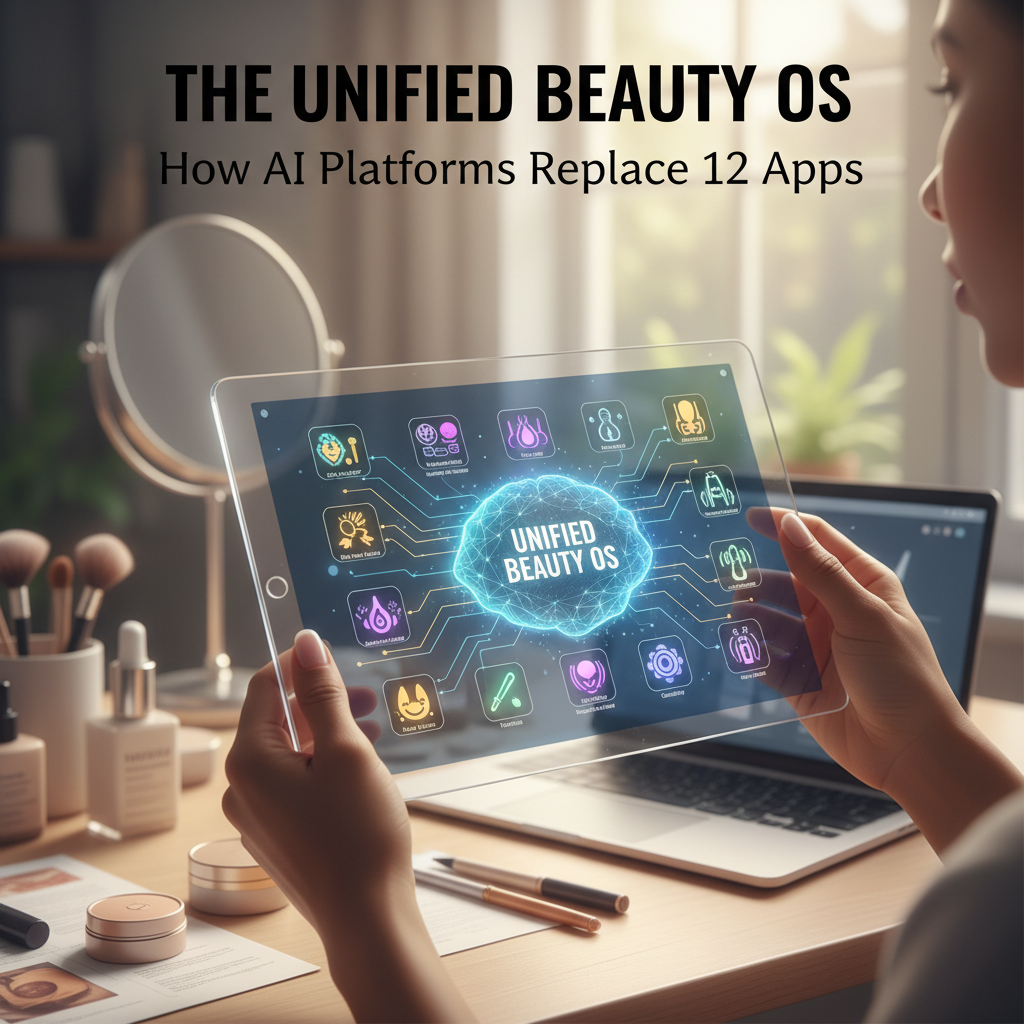
The Unified Beauty OS: How AI Platforms Replace 12 Apps
The Fragmentation of Modern Beauty Tech
For years, salon owners, makeup artists, and beauty entrepreneurs have lived in a state of digital chaos. Running a modern beauty business meant juggling an exhausting array of software solutions. You needed one tool for booking appointments, another for inventory tracking, separate platforms for social media scheduling, and distinct apps for client color formulations. In fact, industry analyses show that a typical enterprise might use up to different digital tools across various departments. Small businesses weren’t far behind, often scrambling across a dozen fragmented interfaces just to get through a single workday.
[IMAGE: A digital dashboard showing a chaotic mess of overlapping software windows representing fragmented beauty apps.]
This digital overload created massive inefficiencies. Staff spent more time updating disparate databases than actually serving clients, and the financial drain of monthly software subscriptions added up quickly. Enter the Unified Beauty Operating System. Powered by advanced artificial intelligence, these all-in-one platforms are streamlining operations by consolidating a dozen separate industry apps into a single, cohesive dashboard.
The Rise of the Intelligent Beauty Ecosystem
The concept of a unified operating system isn’t entirely new, but its application in the beauty sector represents a massive leap forward. Instead of forcing human workers to manually bridge the gaps between scheduling software and marketing tools, AI platforms do the heavy lifting automatically. When a client books a haircut, the system instantly updates inventory, triggers a personalized SMS reminder, logs the product usage formula, and adjusts the staff commission structure without any manual intervention.
Operational streamlining goes even deeper when examining how businesses handle supply chains. Traditional setups required constant oversight, but modern platforms integrate predictive analytics seamlessly. Some logistics frameworks reference standards like to optimize product distribution, ensuring that salons never run out of high-demand items. By centralizing data, these intelligent systems eliminate human error and provide a crystal-clear view of overall business health.
Key Functions Consolidated by AI Platforms
- Appointment scheduling and automated client communications
- Inventory management and automated product reordering
- AI-driven color formulation and skin-analysis tracking
- Staff payroll, commission calculation, and performance analytics
- Integrated social media marketing and reputation management
Transforming Client Experiences and Back-End Operations
Beyond administrative ease, the shift toward a unified beauty OS fundamentally transforms the client journey. Consumers today expect hyper-personalized experiences, whether they are booking a luxury spa day or purchasing custom skincare regimens. AI-driven platforms analyze past purchases, skin types, and stylistic preferences to offer tailored recommendations instantly. This level of customization builds fierce brand loyalty.
[IMAGE: A futuristic beauty salon where a stylist uses an AI-powered tablet to scan a client skin and hair profile.]
On the back end, business owners benefit from unprecedented financial clarity. Financial modeling within these platforms often incorporates robust metrics, drawing on benchmarks similar to to forecast quarterly revenue and overhead costs accurately. Rather than guessing which marketing campaign brought in the most foot traffic, operators can view real-time attribution models generated by the AI.
Overcoming Adoption Hurdles
Naturally, transitioning away from legacy systems comes with challenges. Staff members who have spent years using specific single-purpose tools may experience a learning curve when migrating to an all-in-one ecosystem. However, modern AI interfaces are designed with user experience at the forefront. Utilizing natural language processing, many of these platforms allow managers to pull complex financial reports or update booking rules simply by typing or speaking a command.
Furthermore, security and data privacy remain top priorities. As beauty businesses centralize sensitive client data—ranging from payment details to detailed aesthetic profiles—robust encryption protocols become essential. Compliance standards like often guide the development of these secure cloud environments, ensuring that customer trust is never compromised.
The Future Horizon of Beauty Technology
As we look toward the future, the boundary between physical artistry and digital intelligence will continue to blur. The evolution doesn’t stop at replacing twelve apps; emerging tech stacks, occasionally referenced in tech roadmaps under identifiers like point toward fully autonomous salon management where routine tasks are entirely hands-off.
Ultimately, the Unified Beauty OS represents more than just a software upgrade. It is a fundamental shift in how creative professionals operate, allowing them to step away from glowing screens and focus on what truly matters: human connection, creativity, and the art of beauty.