Deep Dermal Imaging: How AI Reveals What Human Eyes Can’t Detect
Introduction to Deep Dermal Imaging
The human skin acts as a remarkable shield, protecting our internal organs from environmental stressors, pathogens, and ultraviolet radiation. However, this protective barrier also conceals a complex ecosystem of vascular networks, cellular abnormalities, and early-stage pathologies that lie entirely beneath the surface. For decades, dermatologists and medical professionals relied primarily on visual inspections and tactile evaluations, often catching conditions only after they manifested externally. Today, a paradigm shift is underway through the integration of artificial intelligence and advanced diagnostic hardware. Deep dermal imaging is revolutionizing how we perceive, diagnose, and treat conditions hidden away from the naked eye.
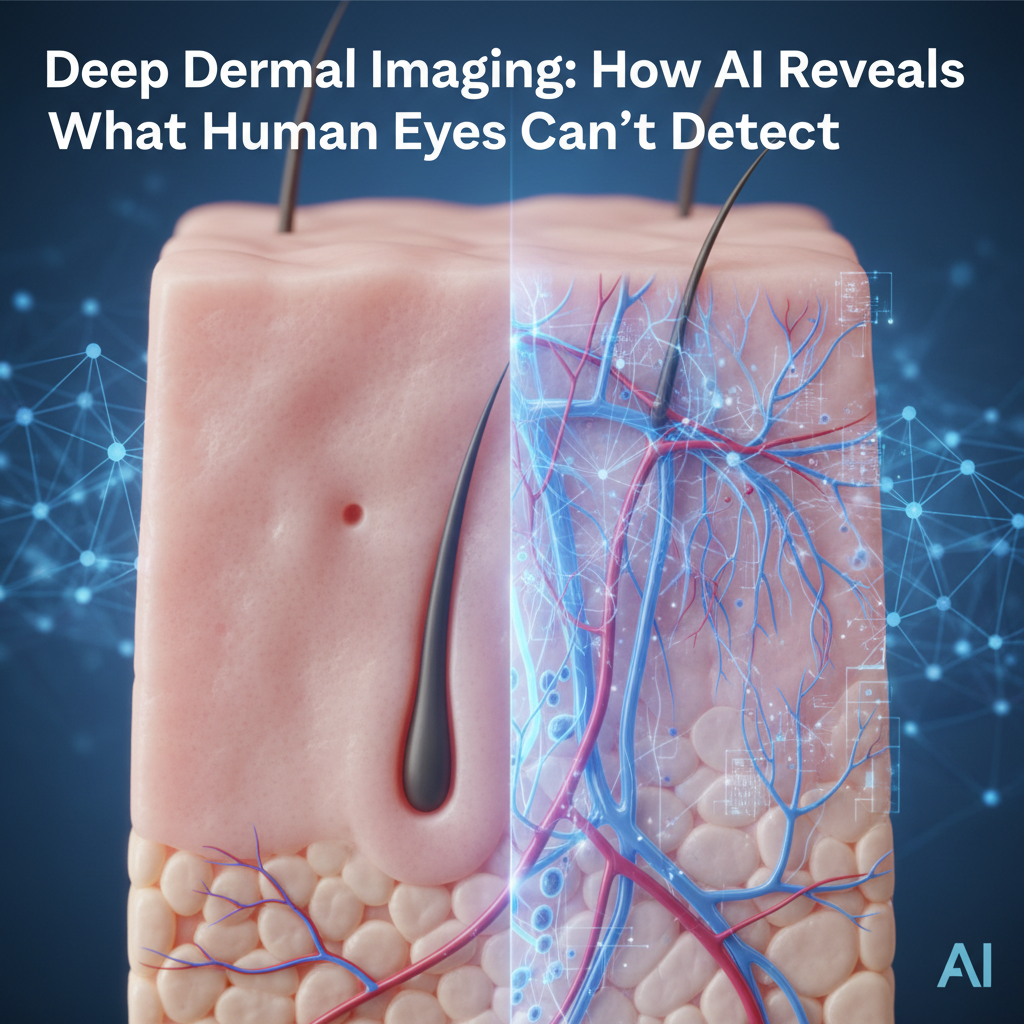
[IMAGE: A futuristic visualization of skin layers being scanned by a glowing optical device showing hidden sub-surface details.]
By leveraging sophisticated algorithms alongside specialized optical technologies, researchers can now peer deep into human tissue. This leap forward goes far beyond standard surface photography, opening up a multi-dimensional window into dermatological health. As machine learning models continue to evolve, they bring unprecedented clarity to medical diagnostics, ensuring that subtle anomalies cannot hide beneath normal-looking skin.
The Mechanics of Sub-Surface Visualization
To understand how modern diagnostic tools achieve such remarkable clarity, it helps to examine the underlying technology. Traditional clinical photography captures only what reflects off the topmost stratum corneum. In contrast, advanced modalities like optical coherence tomography and high-frequency ultrasound penetrate several millimeters into the tissue. These systems generate massive streams of high-resolution cross-sectional data, mapping out cellular architecture with microscopic precision.
Yet, gathering this mountain of raw data creates its own set of hurdles. Managing heterogeneous datasets requires rigorous organization, standardized metadata frameworks, and scalable machine-learning pipelines. This is where specialized data structures and advanced neural networks come into play. By streamlining data processing, researchers can train models on diverse datasets, drastically cutting down false positives and sharpening diagnostic accuracy.
- Non-invasive cross-sectional depth visualization of dermal layers
- Automated margin assessment for dermatologic surgery
- Harmonized data pipelines for multi-center clinical research
Artificial Intelligence as the Ultimate Diagnostic Partner
Human eyes are naturally limited by visible light spectra and physical fatigue. Even the most seasoned clinicians can miss microscopic structural shifts or early cellular mutations hiding deep inside a tissue sample. Artificial intelligence bridges this gap by rapidly analyzing thousands of pixel patterns simultaneously. It compares live scans against vast libraries of historical clinical data, highlighting deviations that might otherwise slip past routine screening.
For instance, when evaluating complex skin lesions, real-time algorithms can assess structural depth and map lateral boundaries instantly. This capability transforms treatment planning, allowing practitioners to verify clear margins before making a single incision. Rather than replacing human expertise, these intelligent frameworks act as an extension of the clinician’s vision, augmenting diagnostic confidence and improving patient outcomes.
Looking Ahead: The Future of Skin Health
The convergence of advanced optics and deep learning algorithms marks just the beginning of a larger healthcare transformation. As these tools become more accessible, preventative dermatology will shift from a reactive discipline to a proactive science. Conditions will be identified at their absolute earliest inception, long before they present physical symptoms on the outer layer of the skin.
Ultimately, deep dermal imaging represents a triumph of modern engineering over biological limitations. By illuminating what human eyes simply cannot detect, artificial intelligence ensures that hidden threats have nowhere left to hide, paving the way for a healthier, more precise era of medicine.